Mexico Insurance Policy
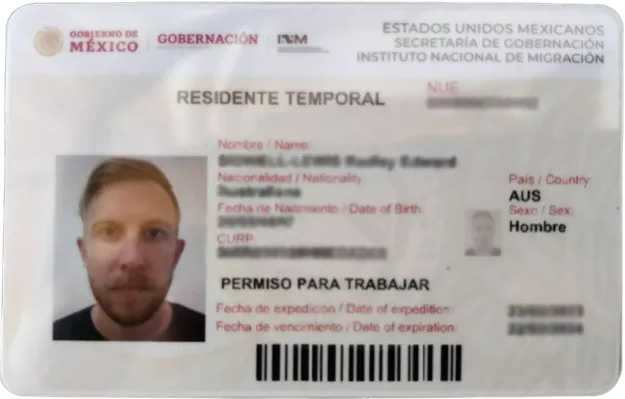
My "Residente Temporal" Card
Recently I wrote about my top 3 picks for geopolitical diversification. Mexico made this shortlist, and I will refer you to the original article here on the details as to why, but briefly, Mexico exhibits only very light physical presence requirements and is presently one of the most accessible countries in the world within which to obtain Permanent Residency (and even citizenship).
Note: This is not intended as legal advice, but rather as a helpful guide.
This article documents the process of obtaining temporary residence permit in Mexico based on my own experience. I cover the Temporary Residence program herein (Residencia Temporal) because this is the visa I was granted, and because while in theory Permanent Residency is obtainable straight off the bat, it is - in most cases, anecdotally at least - difficult to get unless you are of retirement age, or have financial means well above the stated legal thresholds. In any case, as I will outline below, Temporary Residency can ultimately lead to Permanent Residency after 4 years.
Part 1. Getting the Visa
Broadly speaking there are a few basic requirements. Firstly, you need to apply from your home country, or otherwise a country where you hold legal residence. Next, you will need to complete the requisite form, have a passport with at least 6 months' validity and provide a passport size photograph. You will also need to pay for your visa fee (approx. AUD 75 / EUR 46 / USD 50 at the time of writing).
Finally, in order to be eligible for a Temporary Resident Visa for Mexico, you will need to provide proof of financial means. There are two ways to do this:
Income Test: Assuming you are applying as an individual, you will need to prove income of 300 times the Minimum Daily Wage (2023: MXN 207.44) which equates to MXN 62,232 (approx. USD 3,450 / EUR 3,177 / AUD 5,165) per month in the six months prior to your appointment. This is not an average, but rather a minimum amount which needs to be met in each and every month, and ideally for more than the last 6 months (some consulates may require 12 months).
or;
Asset Test: Once again, we are assuming that the individual is applying as a single person. In the case of the assets test the requirement as of 2023 is 5,000 times the Minimum Daily Wage which equates to MXN 1,037,200 (approx. USD 57,567 / EUR 52,956 / AUD 86,070). These assets are defined as being liquid, which means publicly listed stocks or cash balances in the bank. The balance needs to have been maintained for a minimum of 12 months prior to the application appointment date.
When I called the consulate in Canberra, the lady at the other end of the line repeated on several occasions that these figures were minimums by law, and the application is ultimately at their discretion. Demand for this visa has increased dramatically since the pandemic and the ensuing restrictions. Keep this in mind. In theory however, the requirements are universally applicable to citizens of any eligible country.
In order to actually apply in person I made a booking through the online appointment system here. Often this was buggy or didn't work. When I called the consulate in March, they told me that it would be back online in June. I waited, and ultimately it worked. At the consulate in the UAE, a friend of mine was able to book an appointment without the web portal as it was not yet rolled out at that time. Typically however you will need to book - sometimes months - in advance.
On the day of the appointment I arrived early, with hundreds of sheets of paper documenting both my income and my financial assets. In some cases these were stamped by the issuing financial institution, however, in the case that the institution only has online accounts, the consulate may ask to view the balance in your account during the appointment (to confirm the amount in the statement you provide).
A backstory, such as having been to Mexico before, or having contacts there, can only strengthen your application. In my case, proof of financial means above the aforementioned amounts, as well as a backstory around my life as a software developer and businessman helped to solidify my status as a certified "amigo". I was approved. (note: Amigo isn't an official title, but once you are accepted into this exclusive group, your application will more than likely be approved). The consulate staff were great, in fact they even gave me tips on how to ensure I wouldn't become a Mexican Tax Resident - something that you may want to educate yourself on.
Everything went well, and I received the visa that day. Officially, the consulate website states this can take up to a week to be issued (assuming a successful application).
Part 2. Arriving in Mexico
The Residencia Temporal visa glued into my passport allowed me 6 months to enter the country and formalise my status as a Residente Temporal. I tested this almost to its max arriving 5 days before my visa expired (although I have since been advised that some applicants arrive even after their visa has expired and are still able to complete the process. I wouldn't count on this though).
When you arrive at passport control on entry into Mexico, it is imperative that you open your passport to your visa page so as to avoid any confusion as to your visa status. Entering the country as a tourist will invalidate your application, and you will need to restart the entire process from the beginning.
Note: I have been told that at some ports of entry, you will be required to fill out the FMM form and provide this to the immigration officer at passport control. In my case, entering Mexico from Cancun International Airport, I did not need to complete this form.
From the date of entry (which will ultimately be the start date of your Temporary Residence) you now have 30 days to get yourself to a Instituto Nacional de Migración (INM). Until this point, everything had been relatively straightforward.
Honestly, I would highly recommend that you employ an agent to complete this process at this stage. Each INM office seems to operate, to some extent at least, under its own rules, both official and unofficial. For example, at some offices, people line up the night before to hopefully ensure they can formalise the process in the INM offices the next day. In other cases, you first need to visit your local INM office and book an appointment. This appointment to actually formalise your Temporary Residency can be up to 30 days later. During this period before the process is formalised, you need to remain in Mexico.
On the day of appointment, you will need to provide paperwork for the canje (change) as well as pay the relevant government fees for the duration of your permit (1 year initially). I paid approximately MXN 5,000 (approx. USD 280 / EUR 250 / AUD 410). You will also need to provide a utility bill from your place of residence, although your name does not need to be on this bill.
The immigration officer dealing with your case will take your biometric information as well as a photo, and - all going well - you will be provided with your Temporary Residence Card that very same day. Don't count on it going so smoothly though. In fact, in my case, the INM office took an extra week to complete this process for reasons I won't go into here in depth - long story short, my visa had actually expired by the time my appointment took place.
Things to note
So, that is the process in a nutshell. Keep in mind, it is constantly changing and your experience may differ. From now on, when exiting Mexico, you will need to have your passport stamped at the airport INM offices, and when entering, ensure that you enter by presenting your Temporary Resident ID card.
After 12 months, you will be able to renew your Temporary Residence permit for another 3 years, after which point (at the end of 4 years) you will be able to apply for Permanent Residency. After 5 years of maintaining residency (temporary or permanent, or a combination thereof) in Mexico you will be eligible to apply for citizenship, assuming that you speak Spanish and have spent no longer than 180 days in the two years prior to your citizenship application outside of the country.
For some, citizenship may be the aim, for others like myself, having a back-pocket residency permit with extremely low physical presence requirements is enough to help you sleep a little easier at night. I guess you can consider it your Mexican insurance policy.
¡adios, amigos!