Operation Epic Failure
Also available on Substack
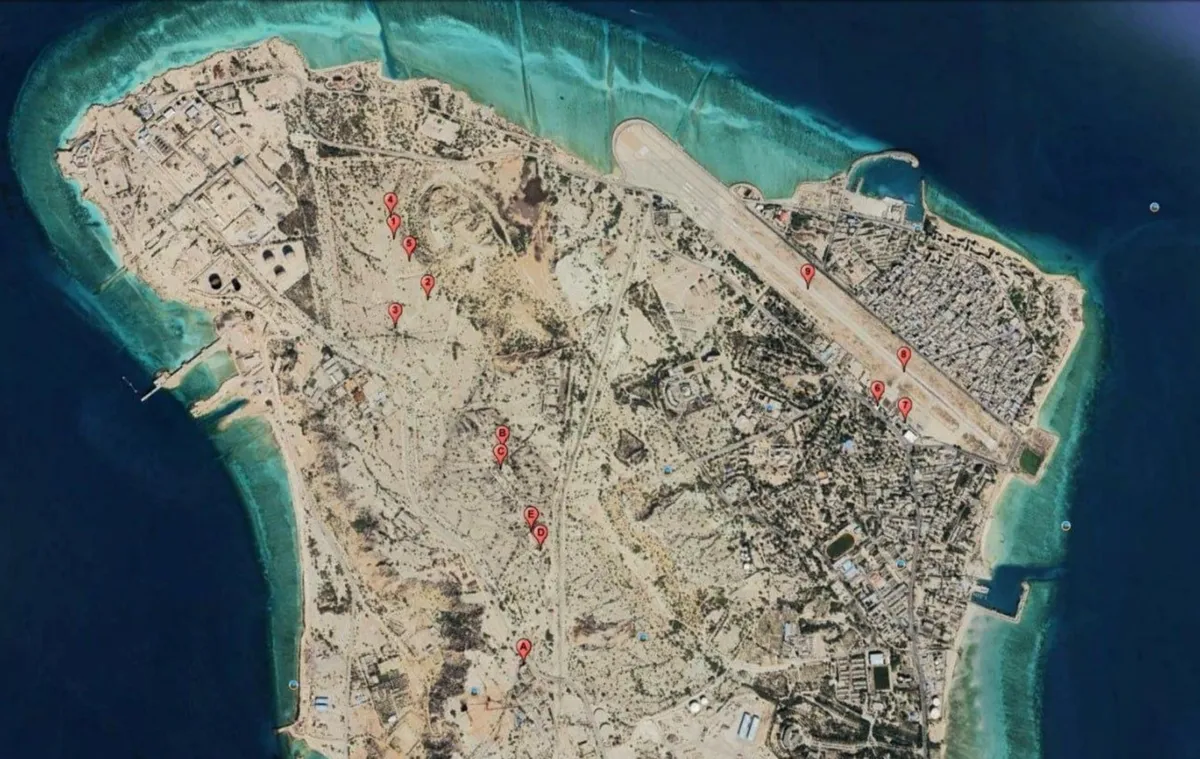
Kharg Island, hit by the U.S. Air Force on 13th March 2026.
This military conflict marks the end of Western dominance in the world, and the end of Western influence as we know it. Anyone who knows me or who follows my work on YouTube or here, will be well aware of my concerns around the direction of not only Europe, but the West more broadly. This war only works to further erode Western economic dominance, and push emerging middle powers towards the likes of China and Russia, fostering the long awaited multipolar moment.
Looking back at the last few decades, one can only lament the incredible opportunity that was squandered. An opportunity for a better, less corrupt, more prosperous world. That opportunity is gone now, buried in the plains, streets and mountains of Iran by the US and Israeli air forces.
It often feels like Western media is a decade behind. News stories about China's rise, or some other part of the world having higher living standards and a lower crime rate than the average Western country betray a naivety and lack of worldliness that is in stark contrast to the West I grew up in. Things have changed, it's just that most Westerners don't know it yet.
A Coherent Strategy
Of course, some may refuse to acknowledge that the old world we dominated no longer exists. If you refuse to acknowledge that China, for example, is already ~20% larger than the USA in PPP GDP terms [1]. If you still expect Russia to collapse any day. If you still think that our so-called democracy is a coherent and robust form of government. If you think this way, then you will naturally argue that this operation is totally coherent because it protects the United States as the global hegemon through denying other powers, specifically China, energy security.
Rising oil prices are not an issue for a United States that controls Venezuelan oil after all. The USA is admittedly insulated from most of the downside that comes with its addiction to foreign wars and military campaigns of destabilisation. That Libya, Syria, Iraq, Iran, Lebanon, Afghanistan, etc., are essentially failed states isn't a material issue for the US, Israel or its collective leadership.
The strategy that the United States is pursuing to maintain global supremacy, might make sense, except that this primacy is impossible to defend and control in the medium to long term. China receives 40-50% of its oil from the gulf[2]. However, their tight-knit relationship with Russia - arguably the largest beneficiary of this war - may transform the situation for China from a unmitigated disaster to a manageable crisis.
China is also a more important trading partner for the GCC than is the United States. Furthermore, while the USA may be protected from the unfolding Operation Epic Fury (or more aptly named Operation Epic Failure), many of its so-called allies are not. From Japan to Australia to Hungary, loyal, obedient allies are set to suffer from this impending energy crisis.
Final breath of liberal democracy
That this war also represents the last gasp of so-called liberal democracy is hardly an overstatement. A huge component of Donald Trump's political success and capital was attributable to a message of anti-globalisation and ending far off wars.
The end of globalisation has certainly begun, with international trade no longer nurtured by the U.S. Navy, and the re-emergence of civilisational fault lines in Eastern Europe, the Middle East, East Asia and beyond. Reshoring, tariffs, and protectionism are back. Nevertheless, the mental gymnastics required to spin this war as positive for the average American are Sovietesque. While the string of failed interventions from Afghanistan to Libya left a tired voting population longing for an isolationist, America-First agenda, this has been undermined entirely by actions which represent the interests of Israel, where American interests are not of secondary or even of tertiary consideration.
Naturally, this is likely to result in greater voter apathy, disenfranchisement, and outright disdain for the Western political system. Polarisation is here to stay, and hardly the hallmark of a prosperous empire.
A declining empire lashes out
But the USA no longer resembles a prosperous empire. Its ability to abuse the reserve currency status it was bestowed upon in the wake of World War II has lengthened the runway of financial and economic hubris and mismanagement. But the United States and the West more broadly no longer hold uncontested leadership across the economic, cultural and technological frontier. China has leapt ahead with battery technology and electric-vehicle dominance, increasingly competitive domestically produced computer chips, and undercuts America's AI dominant proprietary giants with its own, open-source, but highly formidable models[3].
Rather than prosperous and free, the USA looks increasingly divided and unhinged. Leveraging the inertia of a bygone era of prosperity, cohesiveness, productivity and justice that defined its forlorn glory.
The United States' behaviour acts in part as an acknowledgement of the diminishing petrodollar, pushing asset holders wary of the USA's frantic decline into other markets and encouraging settlement of trade in other currencies (such as the increased direct bilateral currency settlements and the recent run-up in precious metals prices).
Compounding this reality is the failure of the US to defend the Gulf States against Iran's harassing drone attacks, which have crippled the flow of vessels through the straits and run down the air defence systems with a new, more effective form of warfare that annuls the United States' unquestionable military-technology advantages.
Soviets, Vietnamese & Iranians
I find it remarkable that the narrative from Israel and Washington is that the Iranian people will rise up and overthrow their government. We don't need to look far back in history to understand that serious countries - such as Iran - actually unite when under attack. Consider the case of the Soviet Union under Joseph Stalin, whose citizens and society made incredible sacrifices to defeat the enemy, despite their tyrannical and despotic ruler, and the unbelievable suffering imposed on the Soviet people by the regime. Wars of national sovereignty are rarely ideological.
Today, Vietnam has embraced capitalism more than any Western country - much like Deng Xiaoping's China -, and yet it was under the guise of communism and the leadership of Ho Chi Minh that Vietnam pushed out the occupier and regained its sovereignty. Clearly, history has taught us that this struggle was not one particularly fixated on communism, as can be seen in the result of modern Vietnam, but rather as a desire by Vietnamese people to eject foreign powers from its soil.
A lesson in history
It is here that a cursory understanding of modern Iranian history reveals a clearer picture. Constant reference is made to the Shah of Iran who was overthrown in 1979, but almost never is it mentioned that Iran's democratic government was itself overthrown in 1953 by MI6 and the CIA in Operation Ajax [4] when the democratically elected Mossadegh's desire to nationalise the Iranian oil industry (heavily controlled by the majority UK government owned British Petroleum) was considered beyond the pale.
It is in this context that I contend the situation in Iran is, like Vietnam, grounded strongly in a desire of a people and civilisation to cast away the foreign occupier and exist on their own terms - for better or worse.
The more interesting question will be whether this war is the catalyst for existing American vassals to desire the same. Europe's economic and cultural stagnation only serves to embed further reliance on its ever hostile ally and is unlikely to ever challenge the USA, or even request it leaves. However, the Gulf Arab states, having calculated and relied upon US protection, now understand their place in the pecking order and are likely to seek a new power, such as China, which already represents a more significant economic trade component than the Americans do.
What next
The war on Iran should be opposed not only because it represents yet another misstep in US foreign policy, but because it will dramatically accelerate the end of global Western dominance. The best outcome of this operation is that the US can maintain its primacy for a few more years, with a failed state in Iran, millions of refugees fleeing to Europe and a volatile energy market and global economy. In the worst case - from a Western perspective - , the USA is ejected from the region, and Iran emerges as a great power.
In his book, Principles for Dealing with a Changing World Order, Ray Dalio points out that it is only when the incumbent power is challenged militarily, that the world will truly understand the strength of the emergent power. In a world of weapons of mutually assured destruction, military challenges necessarily play out via proxies, such as in Ukraine or in Iran. While the nature of war may appear different, the rules remain the same, and this will be the war that resets the perspective as to who really has the power.
Iran, like Thailand, from where I am writing this, was never officially colonised. I hope sincerely that this conflict will be swiftly ended, and that the error in judgment shown by the West is addressed sooner rather than later, and that Iran will tread the line between national sovereignty and integration into an emerging geopolitical system.
References
[1] IMF, 2025, Data Mapper
[2] Politico, 2026, 5 charts show China’s oil dilemma after US strikes
[3] Forbes, 2026, The Top Open AI Models Are Chinese. Arcee AI Thinks That’s A Problem.
[4] Encyclopedia Britannica, 2024. 1953 Coup in Iran